July 21, 2026
Pallet Flow Racking vs Drive-In Racking – Which Storage System Wins?
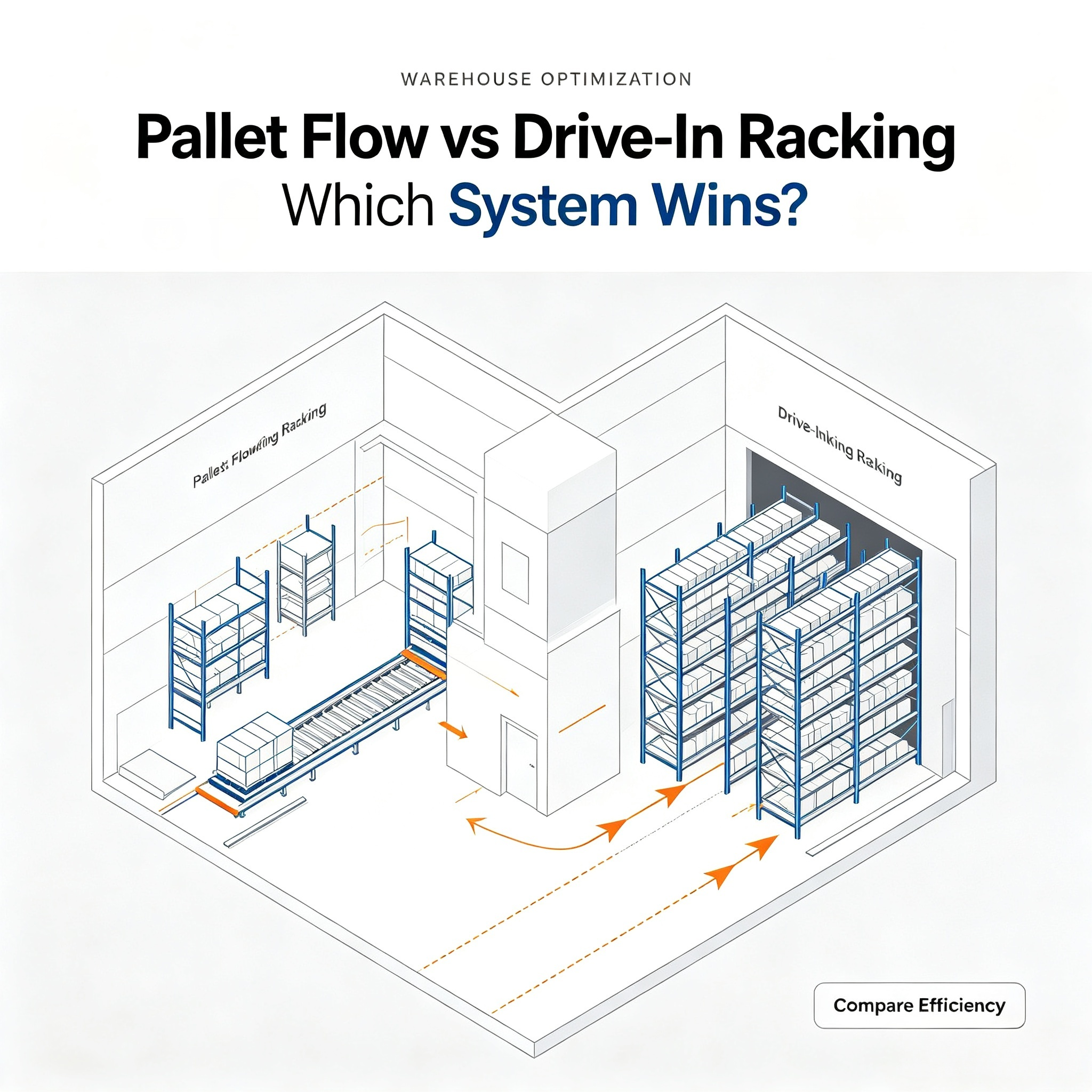
Table of Contents
1. Introduction
2. What Is Drive-In Racking?
3. What Is Pallet Flow Racking?
4. The Real Difference: Throughput vs Pure Density
5. Cost Comparison: More Than Just Sticker Price
6. Case Study: Pallet Flow in Action – Orlando Paint Manufacturer
7. Case Study: Drive-In at Scale – Weaver Popcorn
8. How to Choose: A Decision Framework
9. Frequently Asked Questions
10. Final Thoughts
Introduction
Look, I've been around warehouses long enough to know that when a facility manager starts talking about pallet flow racking versus drive-in, it's usually because they've hit a wall. Either they're running out of floor space, or their forklift operators are spending half their shifts driving back and forth instead of actually moving product.
Both systems are high-density storage solutions. Both eliminate the access aisles that eat up so much square footage in selective racking layouts. But here's the thing – they solve fundamentally different problems, and I've seen too many operations pick the wrong one because they only looked at density numbers.
Let's break this down properly.
What Is Drive-In Racking?
Drive-in racking is exactly what it sounds like. Your forklift drives into the rack structure itself. The system uses continuous rails that support pallets on both sides, and the forklift enters a storage lane to place or retrieve pallets.
Key characteristics:
l LIFO inventory rotation – Last In, First Out. The last pallet you put in is the first one you pull out
l Single entry point – load and unload from the same side
l No rollers, no moving parts – just structural steel and rails
l Virtually unlimited depth – you can go as deep as your building allows
Where does drive-in shine? Cold storage, for one. When you're paying to refrigerate every cubic foot, density is king. Same goes for bulk storage of uniform products – think canned goods, beverage cases, or any situation where you're storing large quantities of the same SKU and don't need to rotate stock frequently.
But I'll be honest with you – drive-in has a dark side. The LIFO constraint means you can't access individual pallets selectively. If you need that pallet buried at the back of a 10-deep lane? You're pulling out everything in front of it first. That's not just inconvenient; it's a productivity killer in the wrong environment.
What Is Pallet Flow Racking?
Pallet flow racking – sometimes called gravity flow or live storage – uses slightly inclined roller tracks. You load pallets on one end, gravity does the work, and they roll down to the picking face on the other side.
Key characteristics:
l FIFO inventory rotation – First In, First Out. Perfect for perishables and date-sensitive goods
l Separate loading and picking aisles – forklifts never enter the rack structure
l Speed controllers (brakes) prevent pallets from gaining too much momentum
l Depth typically 6–20+ pallets per lane
Pallet flow is the go-to for high-turnover operations. Think food and beverage, pharmaceuticals, cosmetics – anything where stock rotation matters and you're moving product through quickly.
The downside? Higher upfront cost, stricter pallet requirements (uniform size and good condition are non-negotiable), and more complex maintenance with moving parts. I've seen jams happen because someone threw a beat-up pallet into a flow lane. Not pretty.
The Real Difference: Throughput vs Pure Density
Here's where a lot of people get tripped up. They look at density numbers and think both systems are interchangeable. They're not.
Let me put it this way: drive-in is a storage strategy. Pallet flow is a throughput strategy.
From an engineering standpoint, pallet flow systems are more about optimizing workflow than just packing in pallets. When you separate loading and picking into independent aisles, you're not just gaining density – you're eliminating the travel time and congestion that kills productivity in high-volume operations.
Drive-in, on the other hand, is pure density play. You're sacrificing selectivity and speed to maximize every square foot.
One stat that sticks with me: drive-in racking can increase pallet positions by 60–75% compared to selective racking. But here's the catch – utilization rates tell a different story. Drive-in systems often run 30–40% empty because bays need to be fully emptied to perform stock rotation. Pallet flow, by contrast, typically achieves around 90% utilization because each lane operates independently.
Table: Pallet Flow vs Drive-In – Key Metrics
Factor | Pallet Flow Racking | Drive-In Racking |
Inventory rotation | FIFO | LIFO |
Typical depth | 6–20+ pallets per lane | 6–12+ pallets per lane |
Storage density | Very high (highest possible) | Very high |
Typical utilization | ~90% | ~60–70% |
Throughput | High – separate load/pick aisles | Low – forklift must enter lane |
Access | All pallets at pick face | Limited – LIFO constraint |
Pallet requirements | Strict – uniform, good condition | More forgiving |
Maintenance | Moderate (rollers, brakes) | Low (no moving parts) |
Cost Comparison: More Than Just Sticker Price
Let's talk money.
Drive-in racking costs significantly less upfront – we're talking about half the price of pallet flow in many cases. Industry pricing puts drive-in around $115–$500 per pallet position, while pallet flow runs $200–$450 per position.
But here's what the price tag doesn't tell you.
When you factor in utilization rates, that cost-per-position advantage starts to shrink. A drive-in system that's only 60% utilized means you're paying for positions you're not actually using effectively. Pallet flow's 90% utilization means you're getting more value out of every dollar spent on rack components.
And then there's labor. In a drive-in system, every pallet retrieval requires a forklift to enter the lane, navigate to the right position, and extract the load. In pallet flow, the operator picks from the face – the system brings the pallet to them. Over a shift, over a year, that time adds up. I've seen operations where the labor savings from switching to pallet flow paid for the premium within 18 months.
Case Study: Pallet Flow in Action – Orlando Paint Manufacturer
AR Racking recently completed a project for a paint, coatings, and adhesives manufacturer in Orlando, Florida. The company needed to maximize space in a specific warehouse zone without expanding the building.
The solution? A pallet flow system covering 3,090 square feet, reaching nearly 20 feet high. The result: 35% increase in pallet count compared to the previous selective rack layout.
Three weeks from start to finish. Same footprint. One-third more storage.
Joseph Talamas, National Sales Manager at AR Racking USA, put it well: "This project is a clear example of how we help clients turn space limitations into growth opportunities". The FIFO layout was critical here – paint has batch codes and expiration considerations, so rotation matters.
Case Study: Drive-In at Scale – Weaver Popcorn
On the drive-in side, let's look at Weaver Popcorn. This is a classic example of drive-in done right.
Weaver needed to lower shipping and storage fees and consolidate manufactured products. Their team evaluated multiple options including drive-in designs and automated shuttle systems.
They expanded their existing drive-in system. The results? Over 3,200 additional pallet positions and elimination of costly off-site storage fees. The installation included 17,200+ feet of angle iron, 8,100+ feet of custom rub rail, and 200 feet of safety guard rail.
Tim Ingle, COO of Weaver Popcorn, described the experience as "seamless" and "turnkey".
Here's the thing about this case – it worked because Weaver's operation fits the drive-in profile: large quantities of uniform product, low turnover requirements, and a priority on pure density over rapid access. Drive-in was the right call for them. It wouldn't be for everyone.
How to Choose: A Decision Framework
So which one wins? Depends entirely on your operation.
Choose pallet flow racking if:
l You need FIFO inventory rotation (perishables, pharmaceuticals, date-coded products)
l You have high throughput with consistent SKU volumes
l You want to minimize forklift travel and operator time
l Your pallets are uniform and in good condition
l You have 6+ pallets per SKU to justify the lane depth
Choose drive-in racking if:
l LIFO rotation works for your products
l You're storing large quantities of the same SKU
l Storage density is your absolute top priority
l You have a tight capital budget upfront
l Your pallets vary in condition or size
One thing I always tell people – don't make this decision in a vacuum. Map your SKU velocity, your pallet condition, your throughput requirements, and your actual floor plan constraints. Bring in the data. I've seen too many decisions made based on "what we've always done" or "what's cheapest per position."
Frequently Asked Questions
Q: Can drive-in racking be converted to pallet flow later?
Not easily. The structural requirements are different – flow racking needs sloped roller beds, brakes, and specific load configurations. Converting a drive-in system typically means starting over.
Q: What about drive-through racking?
Drive-through is similar to drive-in but accessible from both ends, enabling FIFO. However, you lose some density because you need access aisles on both sides.
Q: How deep can pallet flow lanes go?
Lanes over 65 feet deep can be installed. The practical limit depends on pallet weight, roller specifications, and product characteristics.
Q: What pallet types work with pallet flow?
Generally, wooden or plastic pallets that are uniform in size and structurally sound. Damaged or mis-sized pallets cause jams.
Q: Is pallet flow worth the extra cost?
For high-turnover FIFO operations, absolutely. The labor savings and inventory accuracy often justify the premium. For low-turnover bulk storage, probably not.
Final Thoughts
If you're asking me which system "wins," you're asking the wrong question. The real question is: which system fits your operation?
I've walked into warehouses where drive-in was a disaster – operators spending half their day shuffling pallets to get to the ones they needed. I've also seen pallet flow installations where the company paid for premium features they didn't actually need because their throughput didn't justify it.
The best advice I can give? Start with your inventory profile. Map your SKU depths. Calculate your actual throughput requirements. And for goodness' sake, test your pallets in the system before you commit to a full installation.
Both pallet flow racking and drive-in racking are proven technologies. Both have delivered massive ROI for the right operations. Neither is universally superior.
Choose based on your reality, not someone else's.